Table of Contents
- What On-Page SEO Means and Why It Matters
- 1. Title Tags That Communicate Real Meaning
- 2. Meta Descriptions That Encourage Clicks
- 3. URL Structure That Improves Navigation
- 4. Organise Your Information with Header Tags
- 5. Content That Answers Real User Questions
- 6. Placement of Keywords that Support Understanding
- 7. Internal Links That Strengthen Content Networks
- 8. Image Optimisation for Performance and Accessibility
- 9. Mobile Friendliness as a Ranking Requirement
- 10. Page Speed and Core Web Performance
- Final Thoughts
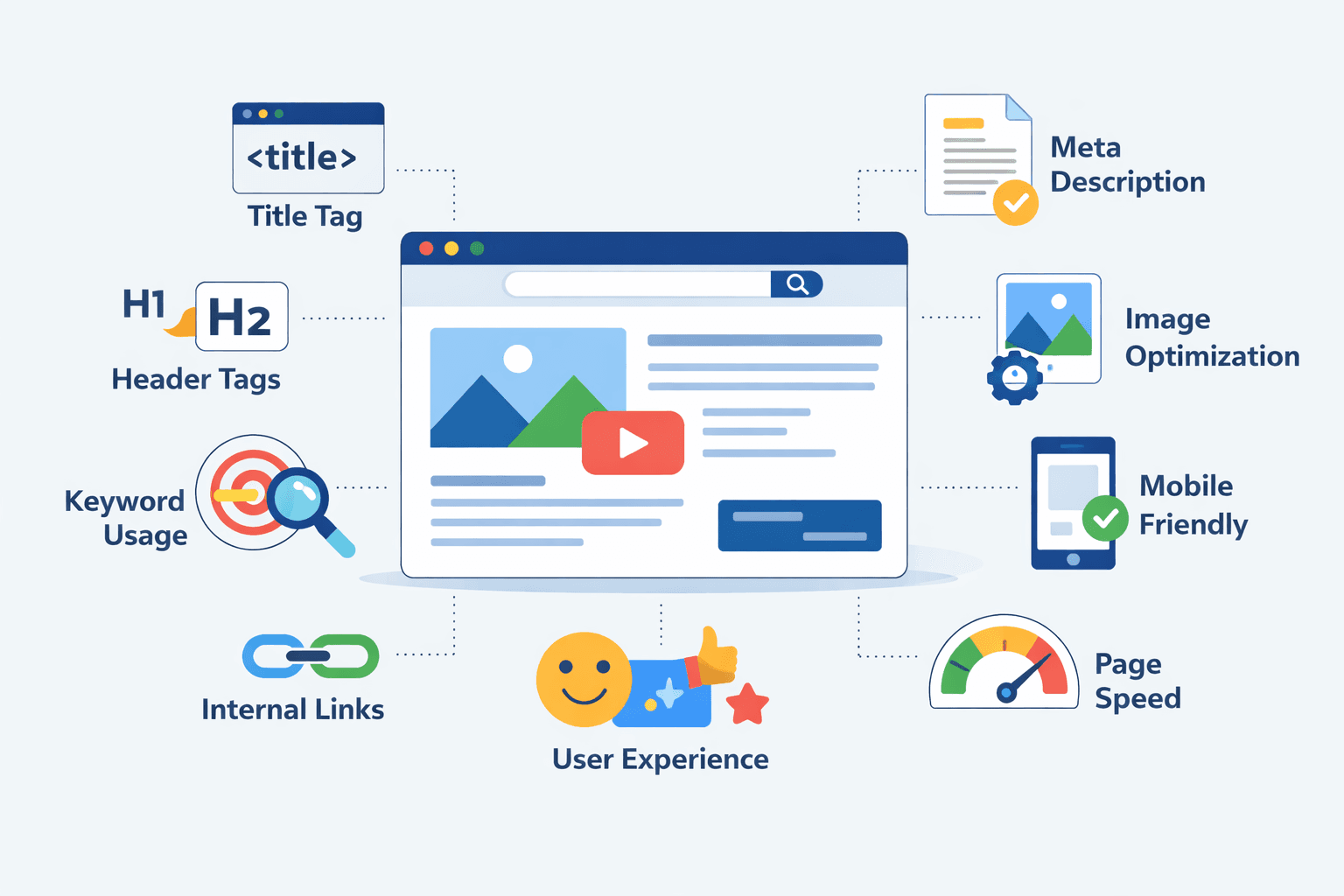
While search engines have become smarter, their ultimate objective remains the same: to determine the core focus of your page, assess its utility, and ensure user satisfaction upon arrival.
Mastering essential on-page SEO elements is the foundation of strong organic performance. When executed correctly, these optimisations make it effortless for search engines to index your content and for users to find exactly what they need.
Many teams prioritise these elements to build pages that are fast, readable, and highly relevant to user intent. This is critical across all industries; for example, a Web Development Company in India must optimise for speed and structure to showcase technical competence, while a Social Media Marketing Agency in India relies on engaging content and clear metadata to capture audience interest immediately.
Understanding on-page SEO factors ensures that every page works harder, supports better ranking potential, and delivers a stronger user journey. These improvements are critical to the broader strategy, often highlighted in the ongoing comparison between on-site optimisation and external authority.
While off-page factors build reputation, internal optimisation is the foundation that sustains it. Below is a detailed breakdown of the ten essential on-page SEO elements every website must master. Inspired by the technical frameworks used by industry leaders like Clicks Gorilla, this guide provides a structured path to mastering organic performance.
What On-Page SEO Means and Why It Matters
Before explaining specific elements, it's important to realise the intent behind them. On-page SEO aims at optimising each of your pages so that search engines accurately understand their meaning.
These improvements shape everything from how your pages rank to how users interact with your content. Every small optimisation inside a page will create a cumulative effect, strengthening the overall visibility.
Teams that consider strong SEO on-page elements usually begin with relevance, structure, and clarity. A page's clear communication of its topic pays off in better ranking potential in the search engines.
For businesses asking which on-page SEO element is most important, experts usually point to intent alignment. That means it should exactly match what users want when they search. When intent, structure, and content quality all match, rankings begin to improve organically.
Many brands also compare on-page SEO vs. off-page SEO to understand how both contribute to growth. Whereas off-page factors like backlinks help search engines trust your site, strong on-page foundations help the search engines understand your site.
Without internal clarity, external authority cannot drive long-term results. This makes internal structure the first step in building sustainable organic performance.
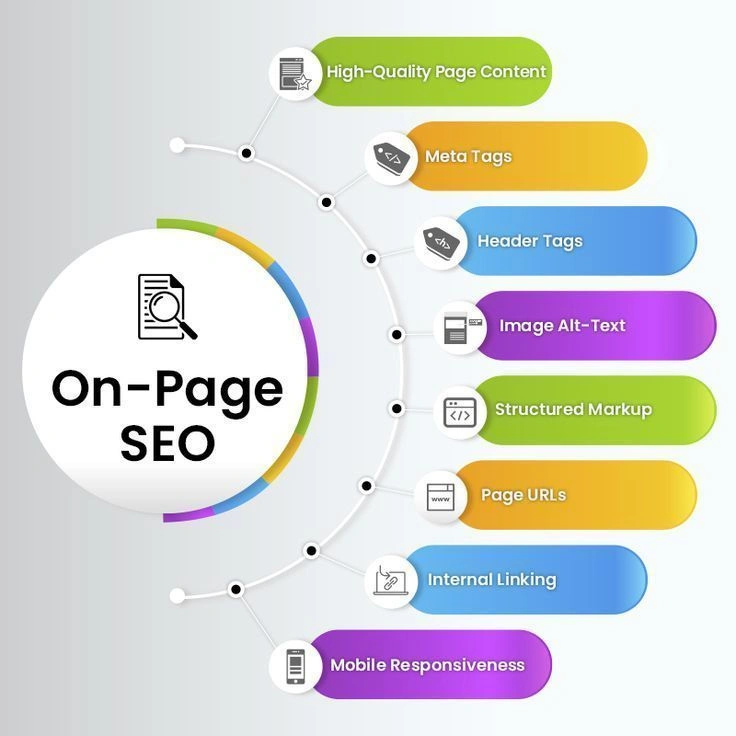
1. Title Tags That Communicate Real Meaning
There's a reason why every list of necessary SEO on-page elements starts with the title tag. Titles represent some of the strongest signals search engines use to understand what your content is about. When your target keyword appears inside the title organically, it helps search engines interpret what your page is about in milliseconds. Clear, descriptive titles will also help boost click-through rates since users instantly know what to expect.
Titles must be written for both search engines and human readers. When aligned properly, they strengthen several on-page SEO factors: relevance, clarity, and engagement. This makes them one of the strongest elements of on-page SEO across all industries.
2. Meta Descriptions That Encourage Clicks
While meta descriptions do not directly influence rankings, they strongly shape user behaviour. A good description encourages curiosity and improves the overall click-through rate. Quite often, pages that receive more clicks from search results tend to perform better over time because search engines interpret this as a sign of relevance.
This simple addition supports your greater SEO on-page elements strategy in the delivery of clarity, trust, and user-centric information. That is why so many brands take the time to refine descriptions, even when they might not be ranking elements.
3. URL Structure That Improves Navigation
Clean URLs build users' trust in one's content and enable search engines to understand the website structure. Often, short and readable URLs, which are keyword-aligned, perform better since they clearly depict what the page is all about. This contributes to stronger elements of on-page SEO, especially when one has various content clusters or category pages.
Search engines like URLs that are organised, descriptive, and logically structured. This factor also enhances overall site navigation and internal linking patterns.
4. Organise Your Information with Header Tags
Headers tell search engines how the content is structured. A clearly defined hierarchy will help search engines understand which parts of your content carry more weight. It also helps readers navigate complex topics and find the information they need more quickly.
These benefits support core SEO on-page elements, such as readability, topical relevance, and clarity of content. Strong header structures enhance the overall flow, allowing your page to be more understandable and potentially perform better.
5. Content That Answers Real User Questions
High-quality content remains the strongest signal across all on-page SEO factors. The search engines give priority to those pages that offer clarity, depth, and useful information. When your content answers user questions comprehensively, it builds authority naturally. This makes the quality of content one of the most important elements of on-page SEO.
Strong pages focus on intent. If a user is searching for comparisons, the page should analyse differences. If a user is searching for how-to guides, the page should offer step-by-step clarity. Matching intent increases both engagement and ranking potential.
6. Placement of Keywords that Support Understanding
Keywords still matter, but their role has changed; instead of simply being inserted anywhere, they must be placed strategically to communicate meaning. Included in titles, headers, introductions, and natural points within the text, they help search engines understand context.
Smart placement bolsters numerous on-page SEO elements because it reaffirms relevance signals. Moreover, it will help search engines categorise your page correctly, which is important in improving discoverability.
7. Internal Links That Strengthen Content Networks
Internal linking is one of the most powerful yet overlooked elements of on-page SEO. By interlinking your pages, you're helping the search engines find deeper content, spread authority, and understand how your topics are related to each other. Such a strategy helps users find their way around your site more easily and stay longer.
Internal links also enable brands to support new pages by linking them to stronger, older ones. This way, indexing happens much faster, and the structure of your site becomes clearer.
8. Image Optimisation for Performance and Accessibility
Images should be optimised both for speed and interpretability. Compressing images enhances loading times, which directly impacts user experience. Descriptive ALT text helps search engines understand what is visually contained in a web page, enhancing relevance in general.
These enhancements support critical SEO on-page elements and also assist users who rely on screen readers.
9. Mobile Friendliness as a Ranking Requirement
Modern search is mobile-first, meaning that search engines evaluate ranking potential based on mobile performance. A responsive layout ensures text is readable, navigation is simple, and interactions remain smooth across devices.
This directly affects several on-page SEO factors that define the users' behaviour on your site: A mobile-friendly page usually retains more visitors, improving the long-term ranking stability.
10. Page Speed and Core Web Performance
Page speed is one of the most critical SEO on-page elements at the moment. Slow pages cause higher bounce rates and lower engagement. Search engines reward pages that load fast since they provide better user experiences. These tend to involve optimising images, reducing heavy scripts, and improving server performance. These improvements help your standing in discussions of On Page SEO vs Off Page SEO, too, since speed impacts internal experience much more than external authority.
Final Thoughts
Mastering these SEO on-page elements creates a strong foundation for long-term organic success. While backlinks and external signals are important, the internal quality of your pages dictates how well search engines understand your content. Clarity, structure, speed, and purpose of your pages automatically ensure results.
Understanding the strongest elements of on-page SEO helps businesses create pages that satisfy both algorithm expectations and user needs. Whether you optimise internally or work with an on-page SEO agency, focusing on these essentials ensures sustainable ranking growth.
As the industry continues to weigh on-page SEO vs. off-page SEO, the brands prioritising internal experience will always come out on top.