Table of Contents
- Understanding the Core Idea: What is DOA in Blockchain?
- What Is a Decentralized Autonomous Organization: Breaking Down the Structure
- 1. Smart Contracts
- 2. Treasury
- 3. Governance Tokens
- 4. Community Driven Direction
- Why DAOs Matter: Transparency and Collective Control
- Blockchain Technology for DOA: The Backbone of Autonomous Governance
- Best Examples of DAOs in Today’s Ecosystem
- MakerDAO
- Uniswap DAO
- How DAOs Run Without Central Leaders
- Decision Making in a DAO
- DAOs in Global Blockchain Culture
- Common Blockchain Terms Connected to DAOs
- Challenges Facing DAOs
- Governance concentration
- Voter participation
- Legal uncertainty
- Technical risks
- The Future of Decentralized Autonomous Organizations
Grasping the emergence of decentralized systems requires taking a few steps back to clearly understand the Decentralized Autonomous Organisation (DAO) in blockchain. The notion that a collective could operate without a central authority sounded impractical, perhaps even inconceivable years ago, yet it is now a practical reality.
Many people wonder how a group can establish rules, coordinate implementation, and move toward collective decision-making using only smart contract code, without the need for managers.
To comprehensively answer what a DAO is, we must examine its structure, purpose, and current real-world implementation. A DAO exists on the blockchain as a decentralised organisation with shared ownership. However, supporting this infrastructure is complex. Whether you require a Cloud & Virtualisation Services Company in India to manage the technical backend, or experts like Clicks Gorilla to guide your strategy, the right partnerships are essential for success.
To be precise about what is decentralised autonomous organisation in blockchain, a DAO is like a digital community that self-governs based on concrete rules that were embedded in smart contracts. This article will unpack the key idea, address the function of decentralised autonomous organisations, explore actual cases of decentralised autonomous organisation operation, and outline the mechanisms that make DAOs one of the most captivating developments in modern governance.
Understanding the Core Idea: What is DOA in Blockchain?
When individuals look into what a decentralised autonomous organisation (DAO) is in blockchain, they typically expect a relatively uncomplicated definition. However, the concept is generalised, requires further conversation, and does have quite a bit of depth. DAOs are organisations that are established on code.
Transactions are transparent. They are owned by the community. The rules are locked into smart contracts, which control every action. This eliminates the hierarchy of traditional management layers. Decisions come from the community.
If you are trying to conceptualise what a DAO is in a more simplified way, you can think about a shared project where each participant can vote to take action. Money is kept in a shared wallet.
Any spending must come through an open proposal, which also requires a vote. Transactions are tracked in the blockchain. Nothing can be obfuscated.
This is the Rule of What is Decentralised Autonomous Organisation (DAO): for the sake of argument, a distributed structure that considers fairness, transparency, and independence from centralised authority.
It is how far blockchain technology for DAO has evolved, and yet where and why developers, investors, and innovators, globally, have been captivated by the trend.
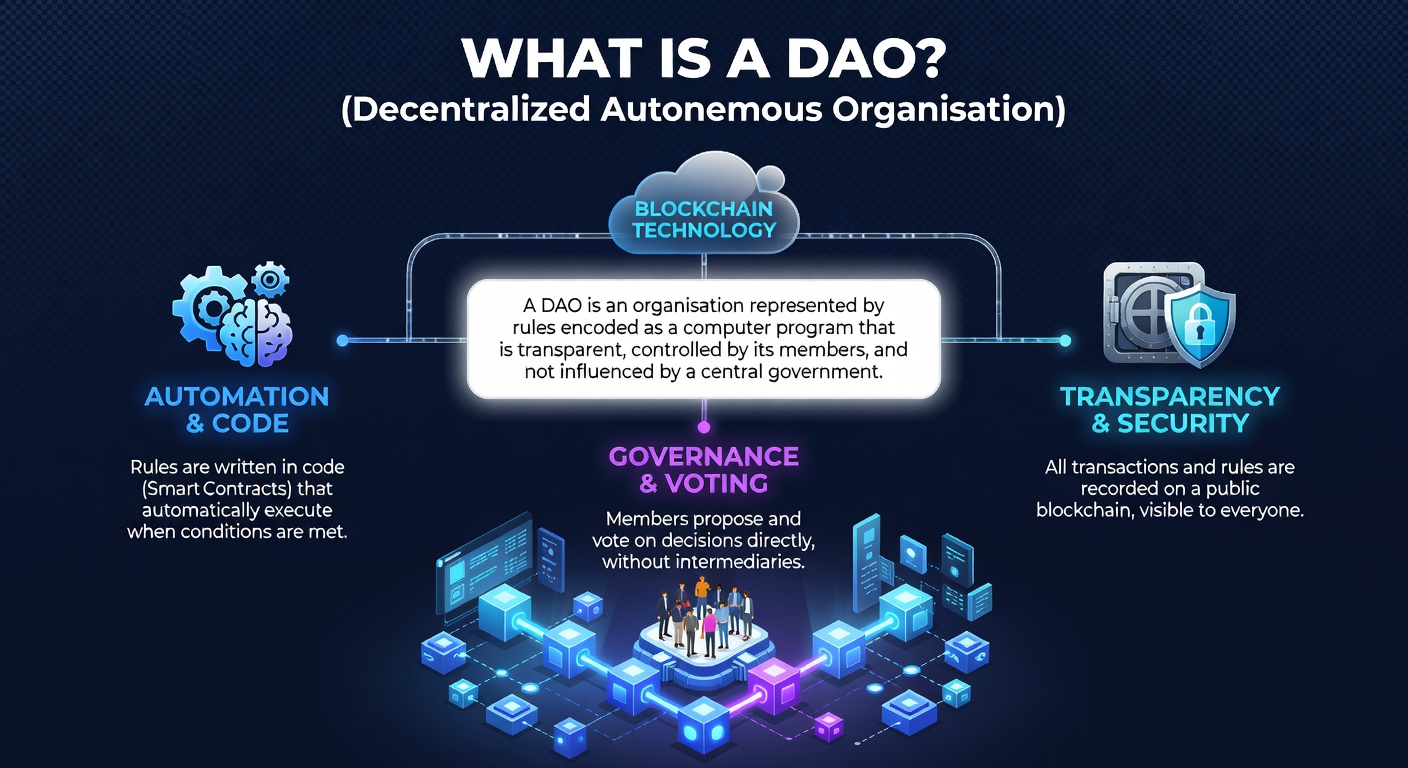
What Is a Decentralized Autonomous Organization: Breaking Down the Structure
People often ask what is a decentralised autonomous organisation is because they want to see how it functions on a practical level. The structure of a DAO has four main parts.
1. Smart Contracts
A DAO is powered by smart contracts. These lines of code define rules, manage treasury access, and automate actions. Once deployed, they cannot be changed without community approval.
2. Treasury
Funds sit inside a shared wallet. No single person can remove them. Every movement requires a vote.
3. Governance Tokens
Voting power usually comes from tokens. Holders can create proposals, vote, and shape the system. The more tokens a person holds, the more influence they have.
4. Community Driven Direction
Everything a DAO does comes from community decisions. This is the core of What is Decentralised Autonomous Organisation. It replaces traditional authority with transparent voting.
Understanding these parts clarifies how doa works and why this structure is different from business models that rely on managers and shareholders.
Why DAOs Matter: Transparency and Collective Control
One primary reason that folks want to look into what is a decentralised autonomous organisation (DAO) in blockchain is to see why DAOs are an important part of modern innovation. The value comes from transparency and shared authority. Every financial transaction can be seen. Every rule is documented publicly. Any change requires member consent.
So it is easy to see why DAOs are key in a lot of blockchain communities. They create trust by removing hidden authority. They prevent anyone from being excluded based on their location. They provide permanent documentation of the decisions made.
Understanding what is a decentralised autonomous organisation (DAO) also shows why a DAO can bypass many of the pitfalls of traditional governance. There is no single point of failure. There are no centralised leaders that act unchecked. Everything is predicated on documentation of verifiable actions made or taken.
Blockchain Technology for DOA: The Backbone of Autonomous Governance
The growth of DAOs is only possible because of strong blockchain technology for DAOs. The blockchain provides immutability, transparency, and security. Every vote and transaction is stored permanently. Smart contracts cannot be changed secretly. The system stays stable even while members join or leave.
This capability explains why so many new DAO projects form each year. Without the stability provided by blockchain technology for DOA, smart contract-based organisations would not be able to operate reliably.

Best Examples of DAOs in Today’s Ecosystem
To fully understand what is a decentralised autonomous organisation is, looking at real cases helps. The current landscape includes some strong models. When exploring the Best Examples of DAOs, several stand out for leadership, growth, and innovation.
MakerDAO
MakerDAO governs the DAI stablecoin system. Token holders vote on stability fees, collateral types, and system risks.
Uniswap DAO
The Uniswap DAO controls the largest decentralised exchange. Token holders shape fee policies, upgrades, and treasury funding.
These two represent only part of the landscape, but they show clear patterns when studying the Best Examples of DAOs in the industry.
How DAOs Run Without Central Leaders
To understand what is Decentralised Autonomous Organisation is, many people ask how something can run without leadership. The answer lies in encoded rules. Smart contracts set the base. Community voting sets direction. The treasury is guarded by code, not people. This makes the organisation both secure and predictable.
When users search what is doa in blockchain, this is usually the most surprising part. The lack of leaders is not chaos. It is structured autonomy.
Decision Making in a DAO
Every part of the process is public. Proposals are posted. Voting occurs. Results are final. All actions become part of the public ledger. This explains why developers and investors trust DAOs for high-value operations.
The clarity helps people understand what a decentralised autonomous organisation is from an operational viewpoint. Every change is visible and approved openly.
DAOs in Global Blockchain Culture
DAOs have become central in many global communities. Conferences, meetups, and research groups now explore new governance models. For example, major gatherings such as blockchain events in Dubai often include large conversations about DAO innovation because the region is growing quickly in tech adoption.
These events help more people understand what a Decentralised Autonomous Organisation is and how the model will influence finance, gaming, digital art, and shared ownership networks.
Common Blockchain Terms Connected to DAOs
People studying DAOs often come across technical phrases, and many want a simple guide to the blockchain terms they will encounter. Terms like governance tokens, consensus, smart contracts, and staking relate directly to DAO activity. Understanding these concepts makes it easier to understand how autonomous systems function without a central operator.
Challenges Facing DAOs
DAOs are powerful, but not perfect. Understanding what is doa in blockchain also means being aware of the limitations.
Governance concentration
Large token holders may have more influence.
Voter participation
Not all members vote, which can limit community strength.
Legal uncertainty
Some regions have no clear laws for decentralised organisations.
Technical risks
Smart contract bugs can cause damage if not audited.
Even with these challenges, DAOs continue to grow because their benefits outweigh their risks when managed responsibly.
The Future of Decentralized Autonomous Organizations
The world is moving toward more open decision-making. This makes it important to understand what a decentralised autonomous organisation is in the context of the future. DAOs will likely govern digital communities, investment pools, creative projects, gaming ecosystems, and global cooperatives. They offer a model where people anywhere in the world can collaborate with fairness and shared control.
This ties directly into the broader definition of What is Decentralised Autonomous Organisation, which emphasises transparency and collective ownership.
Final Thoughts
The interest in what is doa in blockchain continues to rise because DAOs represent a new way to organise people. They reduce dependence on central power and increase trust through transparency. To fully understand the value, one must see why DAOs rely so heavily on community direction and smart contract logic.
With growing adoption, more people study what is a decentralised autonomous organisation and how it will shape industries. As technology expands, DAOs will become easier to launch, safer to manage, and more common in collaborative ecosystems.