Table of Contents
- What is Neural Matching?
- How Neural Matching Works
- Understanding Semantic Search and Neural Matching
- How Google Understands the Meaning Behind Words
- Impact of Neural Matching on SEO
- Writing Content that Matches Google’s Intent Signals
- Adapting SEO Strategies to AI Search Updates
- How Google’s Neural Matching Affects Content Visibility
- The Future of Neural Matching and Semantic SEO
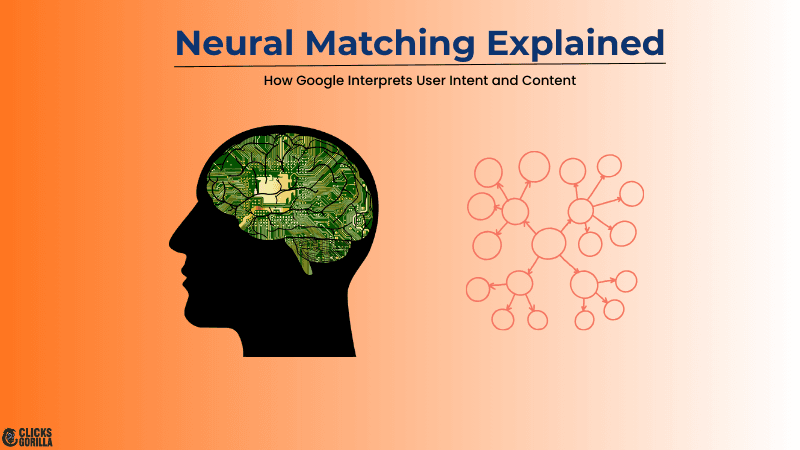
Search engines have evolved far beyond simply matching keywords with queries. Today, Google uses advanced AI systems to understand the true meaning behind what users type or say, and one of the most transformative systems driving this evolution is neural matching. This technology ensures that even a vague search effectively connects a user to the right result, i.e., if he searches for a company e.g web development company residing in a remote town of gujarat he would get the results as “web development company in Gujarat”.
It plays a major role in connecting words to concepts, allowing Google to interpret intent even when a user’s phrasing doesn’t exactly match the words on a webpage. Understanding the difference between neural matching and RankBrain helps SEO professionals and agencies like Clicks Gorilla craft strategies that align with how Google comprehends relevance and meaning in the modern search landscape. But first, before knowing all the technicalities, let us understand what neural matching is and why it is such an integral part of search engines in today’s internet and search engine scenario for every business, including a CMS Development Company in India.
What is Neural Matching?
Neural matching is an artificial intelligence technology introduced by Google to better understand how different words and phrases relate to each other. Instead of focusing on literal keyword matches, neural matching processes the broader semantic meaning behind queries.
For instance, if someone searches for “why is my head pounding after a run,” Google uses neural matching to connect that question to concepts like “headache” and “dehydration.” This means the algorithm can deliver accurate results even if none of those words appear in the query itself.
When comparing neural matching with RankBrain, it’s essential to understand that both utilise AI but serve distinct purposes. RankBrain adjusts results based on user behaviour and contextual relevance, while neural matching focuses on the linguistic and conceptual connections between words.
Together, they make search results smarter and more intuitive, bridging the gap between what people mean and what they type.
How Neural Matching Works
At its core, neural matching uses deep learning to map the relationships between millions of words and phrases across the web. This process enables Google to see the underlying intent in a query rather than just the literal terms used.
It’s particularly effective for long-tail and conversational searches, which often lack direct keyword matches. The system examines how terms appear in various contexts and then determines which pages provide the most semantically relevant responses.
With the rise of voice-based assistants, voice search neural matching has become even more important. Spoken queries tend to be longer and more conversational, often resembling natural human speech rather than keyword-driven inputs.
Neural matching helps Google interpret these spoken questions accurately, improving the quality of results for users relying on devices like Google Assistant or smart speakers.
Understanding Semantic Search and Neural Matching
The connection between understanding semantic search and neural matching is essential to grasping how modern SEO works. Semantic search focuses on understanding user intent and context instead of just keyword repetition. Neural matching enhances this process by enabling Google to find conceptual links across different words and meanings. For example, the search “best shoes for marathon” can be linked to pages that discuss “running footwear for long distances” because neural matching identifies the conceptual overlap between them.
This technology allows search engines to think more like humans, interpreting meaning through patterns and relationships rather than rigid keyword rules. As a result, SEO strategies that rely solely on keyword stuffing or mechanical optimisation are rapidly losing ground.
How Google Understands the Meaning Behind Words
Google’s ability to understand meaning is deeply rooted in how neural networks analyse relationships between terms. By continuously learning from massive datasets, the system refines its comprehension of language, tone, and context.
This is how Google understands the meaning behind words, even when phrased in unique or creative ways. For instance, it can distinguish between “how to plant a seed” and “how to seed a plant,” recognising that both relate to similar intent despite grammatical differences.
This deep contextual awareness means that content creators must focus on clarity, depth, and topical relevance. Search visibility is no longer just about including exact keywords but about writing in a way that satisfies the underlying purpose of a search query.
Impact of Neural Matching on SEO
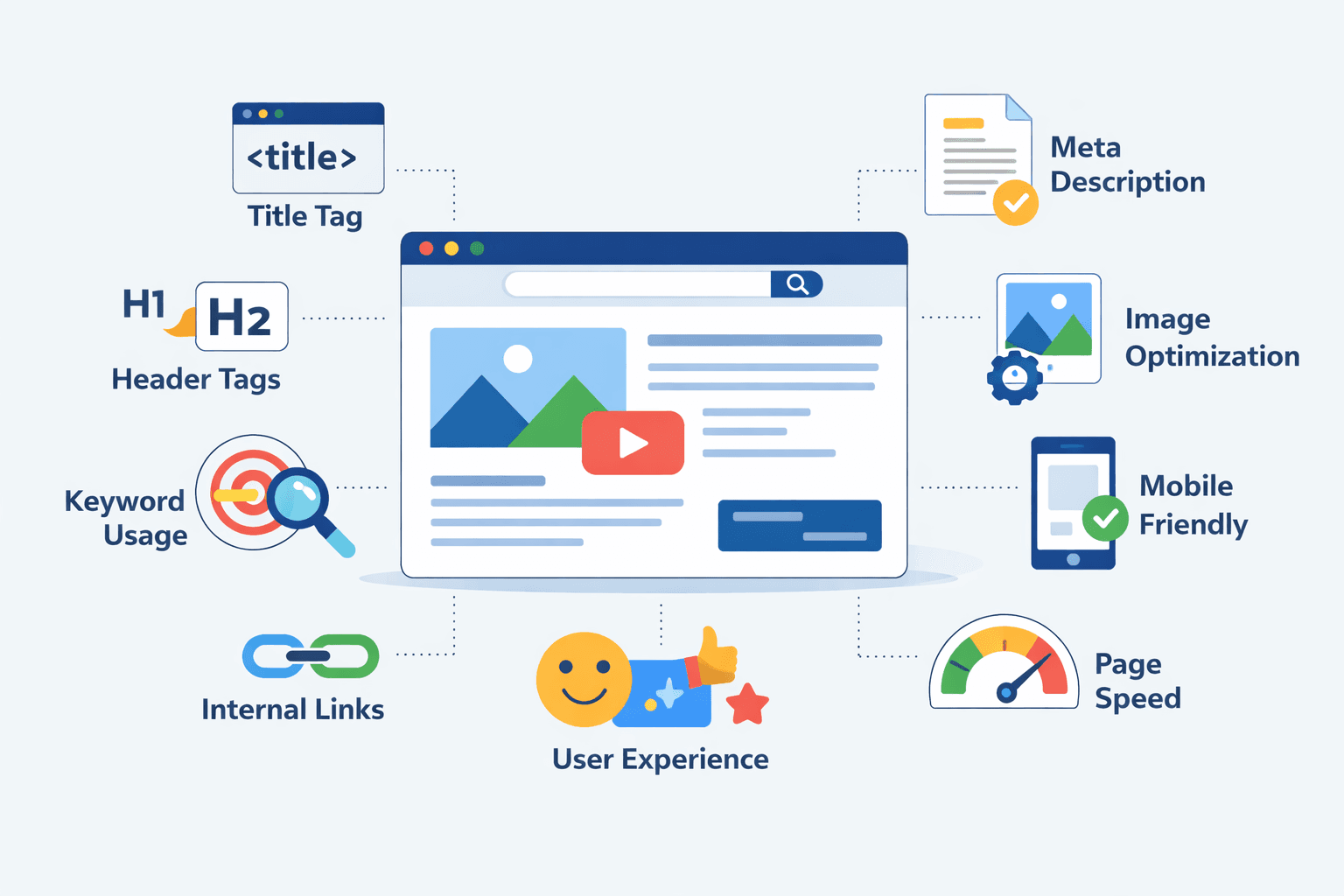
Neural matching has changed how SEO practitioners approach content strategy. Since Google now evaluates meaning and relevance more effectively, content must be genuinely useful, detailed, and written for humans rather than algorithms. Pages that explore topics comprehensively and use related concepts naturally are more likely to perform well than those focused narrowly on keyword density.
Google’s neural matching SEO checklist for 2026 emphasises aligning with intent. It involves creating topic clusters, optimising for natural language, and ensuring your site provides value in various formats like text, visuals, and multimedia. This approach not only enhances rankings but also prepares websites for future AI-driven updates in Google’s search algorithms.
Writing Content that Matches Google’s Intent Signals
Writing for neural matching involves shifting from mechanical keyword optimisation to intent-driven storytelling. When you craft content that directly addresses questions, solves problems, and provides context, you align with writing content that matches Google's intent signals. For instance, rather than targeting “how to cook rice,” you might build an article that explains cooking techniques, mistakes to avoid, nutritional facts, and even cultural contexts of rice dishes. The broader coverage signals to Google that your content comprehensively addresses the topic.
Marketers who master this balance between keyword presence and semantic richness can ensure their pages remain relevant even as AI models like neural matching evolve further.
Adapting SEO Strategies to AI Search Updates
To remain competitive, websites must focus on adapting SEO strategies to Google’s AI search updates. Neural matching and related AI systems like BERT and MUM are part of a long-term shift toward contextual intelligence. The best strategies now prioritise clarity, authority, and user experience. Creating content that builds trust through expertise and authentic insights helps reinforce your site’s authority signals, which complement the way neural matching interprets context.
This adaptation also requires paying attention to performance metrics and technical foundations. Fast loading speeds, mobile optimisation, and structured data all contribute to how effectively Google understands and prioritises your content.
How Google’s Neural Matching Affects Content Visibility
The effect of how Google’s neural matching affects content visibility is significant. Pages that focus on genuine expertise and clear explanations often outperform those that rely on surface-level optimisation. The algorithm rewards depth, context, and the natural use of related terms. For example, an article about “budget travel tips” that also discusses “low-cost destinations,” “affordable accommodations,” and “travel hacks” will perform better because it reflects real semantic variety.
Visibility also depends on how consistently your site produces content that fulfils user intent. Regularly updated and interlinked articles build topic authority, helping Google’s systems associate your site with expertise in specific subject areas.
The Future of Neural Matching and Semantic SEO
As neural matching continues to evolve, it will play a foundational role in shaping the future of search. Google’s focus is moving away from literal text-matching and toward understanding how users think, speak, and seek knowledge. This means businesses must adopt a long-term approach to content creation, prioritising information quality, contextual variety, and emotional relevance.
Ultimately, neural matching makes search engines more human. It bridges the gap between technical algorithms and human language, allowing users to receive results that reflect their real intent. For SEO professionals, mastering this understanding is not optional; it’s essential for maintaining visibility in a world where meaning matters more than keywords.
Conclusion
Neural matching represents a major leap forward in Google’s ability to connect human thought with digital content. It enhances search relevance by interpreting semantics, intent, and contextual depth rather than relying on simple keyword associations.
Understanding neural matching vs RankBrain and the evolution of voice search neural matching is crucial for anyone looking to succeed in modern SEO and make their content stand out in the current competitive scenario.
By focusing on understanding semantic search and neural matching, how Google understands the meaning behind words, and writing content that matches Google's intent signals, businesses can not only future-proof their visibility but also carve out content that makes their pages attractive and appealing in terms of content.