Table of Contents
- What Are hreflang Tags
- How hreflang Works Behind the Scenes
- When You Need hreflang and When You Don’t
- How to Use Hreflang Tags for SEO
- How to Implement Hreflang Tag
- Best Practices and Common Mistakes
- How hreflang Supports SEO and User Experience
- Maintaining Hreflang Over Time
- Troubleshooting Common Hreflang Issues
- Why Hreflang Matters for International Growth
What Are hreflang Tags
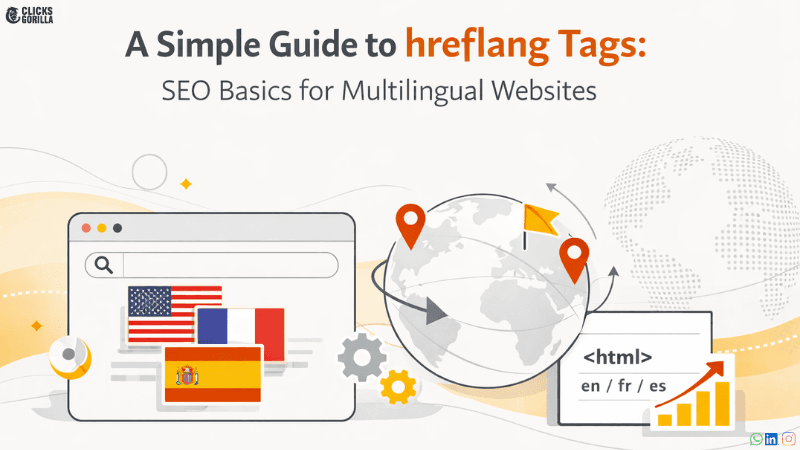
Hreflang allows search engines to discern which language/region was intended for a specific audience by providing a way for a company to provide its customers with pertinent information that is in their preferred language or follows their cultural norms. Hreflang for Multilingual websites is critical if you are a business that offers services or products in more than one language, as it gives customers access to the content that is tailored to their specific culture/region and for that you can hire expert agencies like Clicks Gorilla which is an expert Enterprise Seo company in India providing such services to uplift your business to newer levels.
Search engines view hreflang Tags as a "clue" about clarity and therefore, their usage enhances a business's seo by decreasing the amount of confusion between similar-looking pages. Companies that are striving to optimise their presence in the Global marketplace take advantage of their ability to utilise hreflang for SEO so that customers have a better online experience, get indexed correctly and provide uniformity in the presentation of all of their language versions.
Without the use of hreflang tags, customers will land on the wrong page, thereby diminishing engagement rates and ultimately impacting performance negatively.
How hreflang Works Behind the Scenes
This guide to using hreflang for SEO covers how search engines look at what pieces of content relate to each other based on similar topics but different languages. Hreflang tags enable search engines to tell from which audience a specific version is being targeted when they encounter many different variations of similar pieces of content.
By enabling hreflang to tell search engines that all of the versions are valid translations and not duplicate content, search engines hence treat the content as separate entities and more effectively aid teams in their efforts to create unique languages on their websites and provide users with the content that best meets their needs.
Just like how search engines utilise hreflang tags to determine the relationships between various pieces of content while indexing and ranking those pieces of content, with the help of hreflang tags, your multilingual content ecosystem will be more predictable and stable for users looking to connect with content designed for their region or culture.
When You Need hreflang and When You Don’t
It is important to assess the need for hreflang on your site using a solid hreflang seo guide so you know if an hreflang tag is Vital to your specific multilingual architecture. If your site targets users across different regions, countries, more than one language and offers differing content depending on which Region/Country, the Hreflang tag allows for accurate results to be delivered to the appropriate user by preventing those users from arriving on the incorrect version.
This adds a substantial amount of value to hreflang due to the fact that Search Engines depend on clear signals of which Language they will deliver the content for. If your site has content that varies based on Country, Region, Cultures or Currencies, then the Hreflang is necessary to provide a seamless experience internationally.
However, if the site is only serving one Language for one Region, the Hreflang tag may NOT be necessary. The most important thing is to analyse if the Multilingual structure of your site can actually benefit from introducing this additional complexity. It is also Very Important to note that using hreflang only when it is truly needed will keep your website organised without having to deal with unnecessary overhead and/or having to do Manual maintenance.
How to Use Hreflang Tags for SEO
Many teams have determinations about the proper use of hreflang tags for the purpose of an SEO initiative because an improper implementation may result in indexing issues and conflicting indications. When using hreflang for multilingual websites, every language variation of a page needs to indicate that it has other variations. This indicates to search engines and helps establish clear relationships between those language versions.
Consistent use of hreflang in SEO establishes stronger ties between individual language versions of pages so that search engines are better able to recognise the appropriate language version of a page to provide to a respective user. A frequent error made in the application of hreflang is the failure to maintain reciprocal references, thereby causing search engines not to recognise the connection between pages. If reciprocal references aren't maintained, then the intended version of the page may not show up in the search engine's result pages.
Understanding how to use hreflang tags for SEO requires focus on details, consistent updates, and continuing to adapt to the changing architecture of your multilingual content to have accuracy in context with the other language versions of the page.
How to Implement Hreflang Tag
To learn how to implement an Hreflang tag strategy correctly, you must choose a clear methodology for implementing hreflang tags based on your website's size. With smaller websites, adding hreflang tags directly to each template may be feasible; however, for larger sites that require multiple language versions, utilising centralised management tools such as sitemaps and backend management systems, often recommended by experts at Clicks Gorilla allows for greater efficiency in managing hreflang tags.
Regardless of which option you choose, consistency is the most important factor when implementing hreflangs for your multilingual websites. Consistent implementation creates a single entity that provides search engines with a clear understanding of how they should process and serve hreflangs in relation to multilingual searches, thus allowing you to maintain the effectiveness of your hreflangs to improve your SEO performance, as this will reduce the likelihood that search engines will misinterpret the different variations of your content as duplicate content.
Teams typically look to an example of an Hreflang tag to help ensure that they have correctly aligned the regional and language codes when implementing Hreflang tags. By having a well-organised and properly structured Hreflang foundation, your international content will be easier to find and reference in all search engine environments.
Best Practices and Common Mistakes
An hreflang SEO guide that is comprehensive in nature and, if prepared correctly, will have multiple implementations that commonly have errors. One common error is inconsistent referencing through the various language versions of the hreflang, which will break the relational chain, hence errors along with that.
Another common issue is that teams will incorrectly apply the codes (language or region), which confuses search engines and hence weakens the overall structure of the hreflang for multilingual websites. The errors cause the hreflang to lose its effectiveness as an SEO tool due to the gaps that result from them, preventing search engines from identifying the intended audience. Additionally, there is a frequent pitfall that occurs, whereby the hreflang implementation only occurs once and is not updated progressively through site updates/redesigns.
Consequently, this will result in stale signals that will provide incorrect mappings. Some best practices, recommended by experts at Clicks Gorilla, include regularly reviewing your tags, verifying that you have the correct relationships among the different versions, and validating that all your multiple variations are still current. Finally, small technical errors can create negative impacts on multilingual visibility; therefore, accuracy should be a long-term priority.
How hreflang Supports SEO and User Experience
A detailed hreflang SEO guide provides insights into the benefits of using hreflang tags on your website to improve your users' search experience as well as to enhance their overall search experience. When a user finds content that is written in his or her preferred language, the user will spend more time exploring the site and have a much more positive perception of the credibility of the site. This is particularly true when implementing hreflang tags across multilingual websites, as each market may have different expectations regarding the quality of the content.
Proper implementation of hreflang tags for SEO efforts will create an indirect improvement in search engine rankings by enhancing user experience, decreasing bounce rates, and increasing the likelihood of conversion. By reducing potential frustration associated with finding content that is inconsistent with your search terms, hreflang allows users to navigate through all regions of a brand's website more effectively.
Consequently, brands can create trust with consumers in every region of the world and demonstrate the value of developing accurate language targeting strategies as part of their overall strategies for Global marketing.
Maintaining Hreflang Over Time
Once businesses implement their hreflang, they often neglect the continual care and upkeep required after it’s been set up. A reputable hreflang SEO guide indicates that you will need to keep updating the hreflang when new pages, translations, or regionally different versions of the same content are created. For those teams responsible for managing hreflangs for multilingual websites, this means closely monitoring their website structure, reviewing changes to the structure regularly, and conducting tests regularly to make sure that every hreflang version remains connected.
Having a maintenance program established for your hreflang protects the way you use SEO by ensuring that outdated message signals do not confuse search engine results. Any changes you make to your URLs, or to the way content is organised in relation to a user experience, also require reviewing the connections of their hreflang.
By treating your hreflang as if it were alive and updating it as necessary, your multilingual environment will be performing consistently and at a higher level of stability in the long run.
Troubleshooting Common Hreflang Issues
Troubleshooting, as often emphasised by Clicks Gorilla, requires understanding where mistakes typically occur. A reliable hreflang SEO guide helps identify mismatched codes, missing self-references and incomplete clusters. For businesses using hreflang for multilingual websites, discovering these errors early prevents long-term search confusion. When hreflang breaks down, hreflang for SEO signals weaken, leading search engines to guess which version should appear.
This increases the chances of users landing on pages in the wrong language or region. Periodic audits help avoid such problems and maintain performance. Troubleshooting may include adjusting codes, rechecking page relationships or verifying that all variations reflect structural changes. By addressing issues proactively, you preserve the integrity of your international strategy and maintain search visibility across all markets.
Why Hreflang Matters for International Growth
A strong global presence requires a structured multilingual foundation supported by accurate hreflang. Following a dependable hreflang SEO guide allows brands to deliver personalised experiences to international audiences. When combined with hreflang for multilingual websites, hreflang increases clarity for search engines and helps them index your content correctly across borders.
This improves hreflang for SEO results by ensuring the most relevant version always appears, reducing barriers for international customers. Hreflang becomes a strategic asset for companies planning long-term expansion because it clarifies the linguistic and cultural scope of each page. It builds trust with international visitors and supports a more refined global approach.