Table of Contents
The question of whether a domain name affects SEO in 2026 is one that many website owners and marketers are asking today. In the past, having a keyword in your domain name almost guaranteed better rankings. However, Google’s algorithm has evolved. It now emphasises authority, user experience, and relevance instead of just blatant keyword matching. This is especially critical in high-stakes industries; for example, a reputable Cybersecurity Solutions Company in India gains far more traction from a domain that conveys trust and professionalism than from a generic, spammy-looking URL.
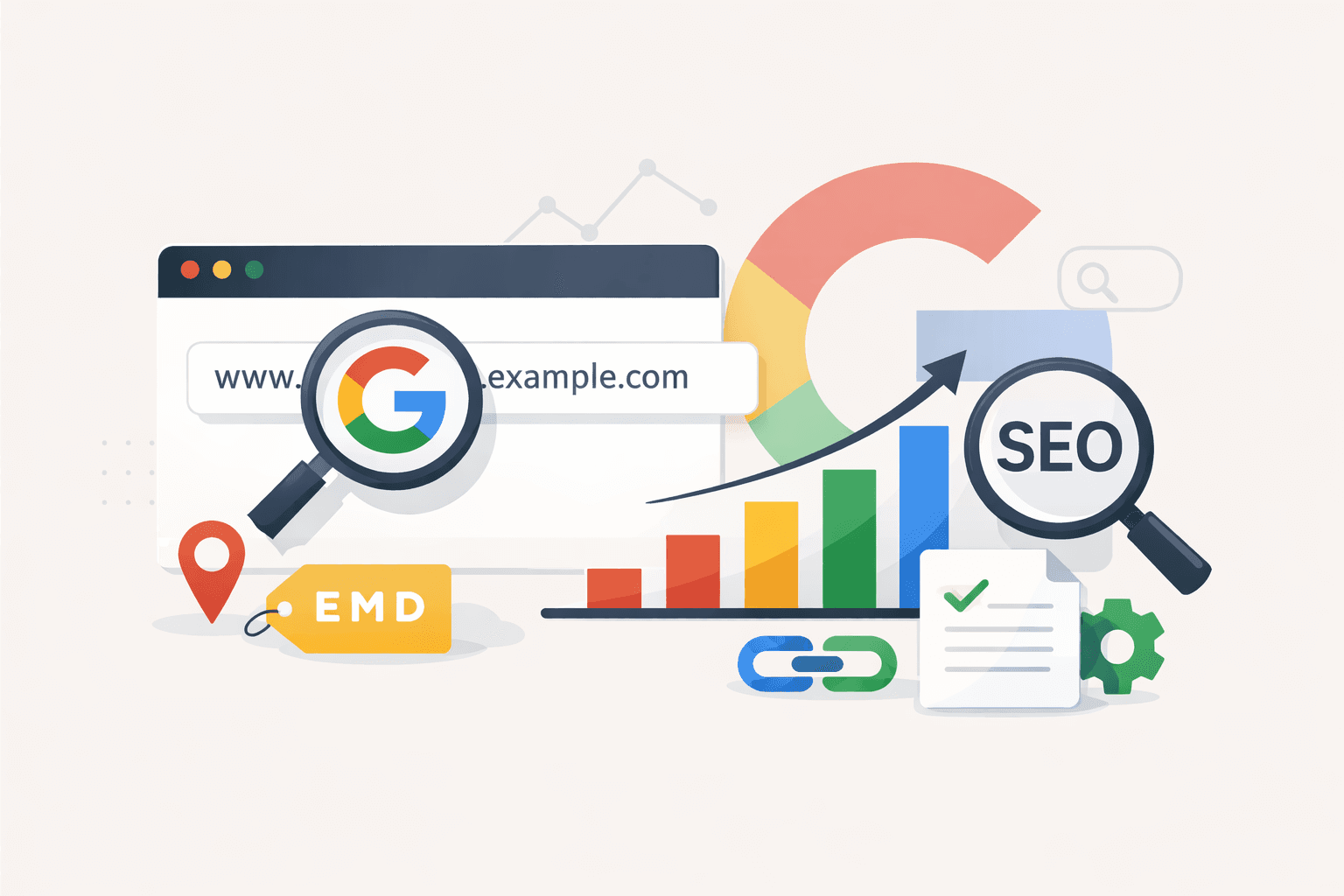
An exact match domain (EMD) is a domain that perfectly matches a target search phrase, such as bestshoesonline.com. Years ago, this tactic could push a site to the top of Google easily. But after Google’s EMD update, the search engine began penalising low-quality websites that relied solely on such domains. This is why modern agencies like Clicks Gorilla advise clients to prioritise unique, brandable names that support long-term growth rather than relying on the "cheat code" of exact match domains.
Now, does a domain name affect SEO in 2026? It depends on how the domain complements your brand and content quality. A strong domain helps with user trust and click-through rate, but it’s only one piece of the SEO puzzle.
Pros and Cons of Exact Match Domains
Now that we have a basic understanding of EMD, having an Understanding of the pros and cons of exact match domain ownership is crucial before making any decision.
Advantages: An EMD can improve brand recall and click rates, especially for small businesses targeting specific niches. For instance, a domain like handmadecandles.com instantly tells users what the site is about.
Disadvantages: On the other hand, such domains can appear generic, lack unique identity, and risk over-optimization. Google now prioritizes authority and content quality, not keyword repetition. Hence, if an EMD doesn’t provide strong user value, it may not perform well long-term.
When and How to Migrate from an EMD
Sometimes, it becomes necessary to migrate from an exact match domain to a more branded version. Businesses that outgrow niche domains or face ranking issues due to past EMD practices often make this switch.
The migration process requires careful planning. Every URL must be redirected properly using 301 redirects, sitemaps updated, and internal links reviewed. Submitting these changes through Google Search Console ensures that search engines recognize the new site and retain link equity. A smooth migration preserves rankings and avoids confusion among returning visitors.
EMD, PMD, and Branded Domains: The Key Differences
Many marketers confuse the difference between EMD, PMD, and branded domains.
Here’s a quick breakdown:
-
EMD (Exact Match Domain): The domain matches the target keyword exactly, such as besthotelsinparis.com.
-
PMD (Partial Match Domain): Contains a part of the keyword, like parishotelguide.com.
-
Branded Domain: Focuses on brand identity instead of keywords, such as Booking.com or Airbnb.com.
While EMDs used to provide ranking benefits, branded domains now dominate because they build credibility, emotional connection, and flexibility for future business growth.
Myths and Misconceptions About EMDs
There are several myths about exact match domains and penalties. Some marketers believe owning an EMD automatically leads to penalties, which is false. Google doesn’t punish EMDs by default; it penalizes low-quality content and manipulative link practices.
If an EMD website maintains unique, valuable, and user-friendly content, it can still perform well. What matters most is not the domain type but the quality signals that support it backlinks, engagement, and relevance.
Optimizing an Exact Match Domain the Right Way
Knowing how to optimize an exact match domain site is key to maximizing its SEO potential. Focus on creating comprehensive, trustworthy content around your target keywords rather than repeating them excessively. Build backlinks naturally, use structured data where appropriate, and ensure fast page load times.
Also, reinforce brand identity by using a professional logo, consistent tone, and active social profiles. This helps your EMD stand out as a real business rather than a keyword-driven site.

When Recovery Becomes Necessary
Some businesses may face ranking drops or visibility loss due to over-optimization or old EMD tactics. In such cases, working with SEO agencies that specialize in exact match domain recovery can be helpful. These experts analyze backlink profiles, content quality, and technical issues to restore trust and rankings.
Recovery is not about abandoning your domain but improving it to meet modern SEO standards. Quality backlinks, improved site structure, and updated content are the foundation of recovery strategies.
Modern SEO and Branding Balance
The relationship between branding and SEO has changed drastically. Instead of relying on keywords in domain names, Google now values websites that provide genuine user satisfaction. High-quality content, secure websites, and consistent branding play a bigger role in visibility.
Whether a domain name affects SEO remains an important consideration; it’s not the deciding factor. Businesses that rely purely on EMDs without strong brand signals often struggle to maintain rankings against established competitors.
The Future of Exact Match Domains
The pros and cons of the exact match domain approach will continue to evolve as Google refines its ranking systems. Exact match domains are not obsolete, but their success depends entirely on context. For local or niche markets, they can still offer an advantage. However, for long-term scalability, branded domains hold greater potential.
Modern SEO success lies in balancing keyword relevance with brand personality. The key is to integrate both effectively while focusing on user trust and long-term engagement.
Final Thoughts
As SEO continues to mature, domain strategy must align with Google’s broader emphasis on authenticity, expertise, and usability. Whether you’re debating between keeping an EMD or shifting to a brand-based approach, remember that quality content and user experience outweigh any short-term advantage.
Understanding the difference between EMD, PMD, and branded domains helps make smarter decisions that sustain visibility over time. And if your site ever struggles, collaborating with SEO agencies that specialise in exact match domain recovery ensures expert guidance.
Ultimately, a domain name can set the stage, but it’s your strategy, content, and consistency that decide how far your website climbs in the search results.