
Table of Contents
- How Redundancy Threatens SaaS Visibility
- What Exactly Is Google’s Deduplication System?
- How Google Deduplication Impacts SaaS Company Rankings
- Is Deduplication the Same as a Penalty?
- Signs Your Site Is Being Deduplicated
- Fixes for Deduplication
- How to Prevent Deduplication of Featured Snippets
- How to Make Content Unique to Avoid Google Deduplication
- The Relationship Between Deduplication and Canonical Tags
- The Real Impact on Rankings
If you’ve been following Google’s algorithm updates closely, you know that the search giant has been passionately following one mission throughout the years: to make results cleaner, more accurate, and more user-friendly. This constant refinement often leads to organic volatility, which is why forward-thinking brands now view Google Ads Services in India not just as a marketing channel, but as necessary insurance against these inevitable algorithmic shifts.
One of the most significant changes in that direction is the deduplication system, a quiet but powerful update that reshaped how websites appear in search results. Strategies recommended by agencies like Clicks Gorilla have had to adapt rapidly to this new reality to ensure clients don't lose their foothold.
While many welcomed deduplication as a way to reduce clutter, others, especially SaaS and content-heavy businesses, began to notice something strange: disappearing links, fluctuating rankings, and a decline in visibility.
For companies in competitive tech hubs, this often necessitates a pivot to hyper-localised strategies to regain the ground lost to these cleaner, stripped-down organic results.
How Redundancy Threatens SaaS Visibility
The heart of the issue lies in how systems interact with one another. For years, canonical tags have been the go-to method for consolidating duplicate URLs and directing authority to the main version of a page. But Google’s deduplication algorithm takes it further. It automatically filters out what it considers repetitive or redundant results, even when the site owner didn’t intend for that to happen.
For companies operating in competitive niches, understanding how Google deduplication impacts SaaS company rankings is essential. Because this feature is such a prominent aspect, it includes everything from affecting visibility, traffic distribution, and even how featured snippets behave. Failing to understand it can mean losing valuable real estate on the SERPs without realizing why.
What Exactly Is Google’s Deduplication System?
Google deduplication refers to the process of removing duplicate listings of the same content in search results. Before this system was introduced, a website could appear twice, once as a regular blue link and again as a featured snippet. But after the deduplication update, Google now shows only one version of that page, preventing redundancy in search results.
In other words, if your content earns a featured snippet, it will no longer appear again in the organic listings below. This means your site gets just one slot per query, which can be both a blessing and a curse depending on your strategy.
This mechanism isn’t limited to featured snippets. Google’s system now uses AI-based content analysis to detect similar or identical information across different URLs. If the algorithm considers two pages too similar, one might be filtered out.
This automated choice, which doesn’t always align with a webmaster’s canonical preference, is why Google’s deduplication vs canonical tags explained is such an important topic. Canonical tags suggest which page should be prioritized, while deduplication decides which one actually appears. Understanding that difference is key to keeping your most important pages visible.
How Google Deduplication Impacts SaaS Company Rankings
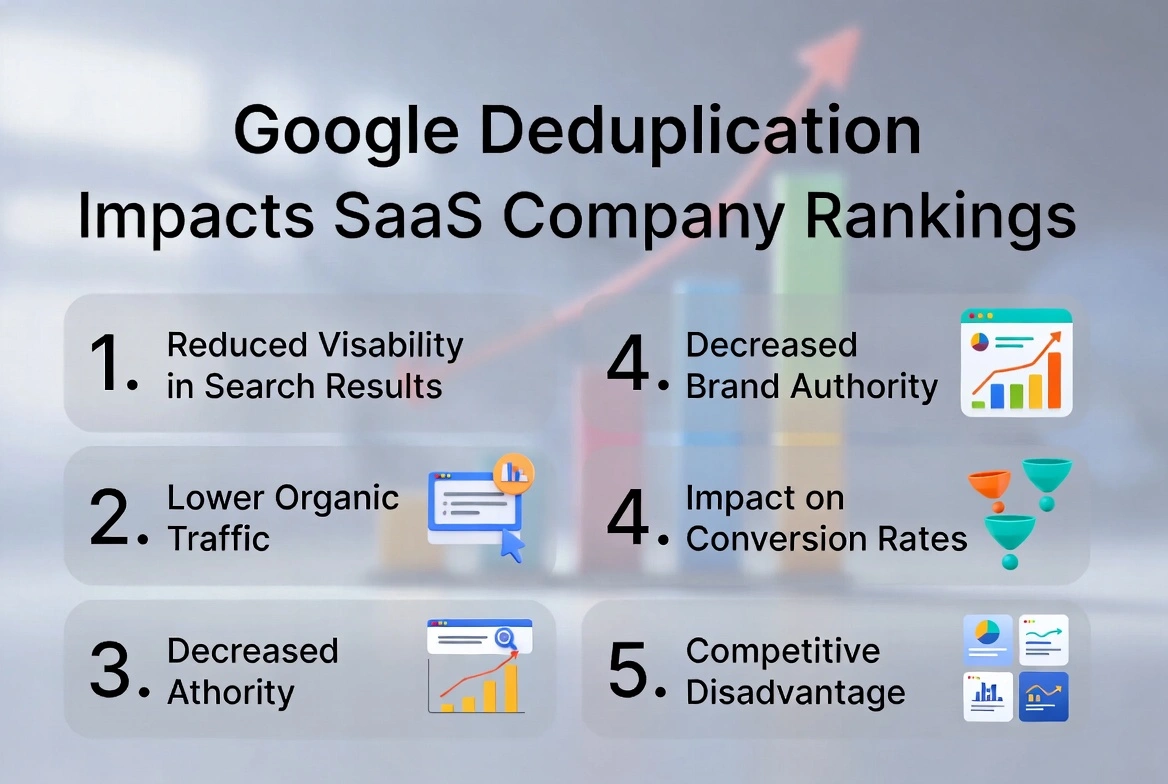
For SaaS businesses, the stakes are even higher. The SaaS industry thrives on content-driven growth, blog posts, documentation, tutorials, and case studies often overlap in topic and structure. When Google’s system detects multiple pages with similar intent, it may suppress some of them even if each serves a unique purpose.
That’s why understanding how Google deduplication impacts SaaS company rankings is critical. Imagine having three valuable resources: one explaining a product feature, one offering a use-case guide, and another addressing troubleshooting. If Google flags them as “too similar,” you could lose visibility for two out of three pages, directly reducing your organic reach.
This is particularly dangerous for SaaS companies because their products often target the same core topics, their content strategy naturally overlaps around keywords, and they rely heavily on organic traffic for conversions and onboarding. So, when the deduplication filter activates, visibility and conversions can drop even when your technical SEO seems perfect.
To counteract this, SaaS marketers must focus on differentiation. Instead of optimizing multiple pages for similar intent, consolidate where possible and clearly define unique value propositions. This not only minimizes the risk of being filtered out but also strengthens topical authority.
Is Deduplication the Same as a Penalty?
This is one of the most misunderstood aspects of the system. Many site owners panic when they see a sudden drop in rankings, assuming they’ve been penalized. But in most cases, the reason for the penalty isn’t that, so the question that remains unanswered is deduplication the same as a penalty? The answer is no, it’s not.
A penalty, whether manual or algorithmic, implies that Google has found something against its policies, such as spammy content or unnatural links. Deduplication, on the other hand, is an automated process designed to simplify search results. Your content isn’t being punished; it’s just being filtered out in favor of what Google deems the “best representative” of that information.
That said, the effect can feel like a penalty because your impressions and clicks drop. To avoid confusion, always check your Search Console coverage and performance reports. If you don’t see manual actions or warnings, it’s likely just deduplication, not a punishment.
The key takeaway is that deduplication doesn’t hurt your credibility or authority; it just reduces redundant visibility. But when left unchecked, that reduced presence can still affect conversions and growth, especially in industries like SaaS and eCommerce.
Signs Your Site Is Being Deduplicated

Many webmasters don’t realize their pages have been affected by deduplication until their rankings start to fluctuate.
Some common Signs your site is being deduplicated include:
-
A page that previously ranked twice, once as a snippet and once organically, now only shows once.
-
Similar pages targeting identical keywords see inconsistent visibility.
-
Impressions drop in Search Console without a drop in crawl frequency or index status.
-
Content that appeared in “People Also Ask” or snippet boxes no longer shows in regular listings.
If you notice these changes, it’s likely your website has undergone Google’s automated filtering. While this isn’t inherently bad, it requires strategic adjustments to ensure your key pages aren’t being suppressed.
Fixes for Deduplication
When it comes to Fixes for deduplication, the goal isn’t to trick Google; it’s to make your content structure and signals clear enough that Google chooses correctly which version to rank.
You can start by auditing similar content regularly and merging or reoptimizing pages for distinct purposes. Strengthen canonical tagging and make sure your tags are consistent, pointing clearly to the preferred version.
Optimize headings and metadata with descriptive titles that differentiate each page, even if the topics overlap. Use unique internal linking to guide Google toward the right pages and avoid confusing anchor texts. Structured data can also help Google understand page context more accurately, reducing the risk of deduplication.
Fixing deduplication is not about deleting pages but clarifying their relationships. When Google can clearly distinguish each page’s purpose, it stops treating them as duplicates.

How to Prevent Deduplication of Featured Snippets
Featured snippets are among the most visible spots in Google results, but they are also among the first to trigger deduplication. Once your content earns that top snippet, it will no longer appear as a regular link below. For some queries, this can actually reduce total clicks.
To manage this, you must learn how to prevent deduplication of featured snippets from harming your CTR. Evaluate whether the snippet position truly benefits you. If your snippet gives away too much information upfront, users might not need to click through. Consider rewriting snippet-worthy content to tease value rather than provide the full answer.
You can also use the data-nosnippet tag to tell Google not to display specific sections as snippets. This ensures your content remains in organic results without being filtered. For SaaS landing pages, where clicks translate directly into leads, this small adjustment can make a major difference.
How to Make Content Unique to Avoid Google Deduplication
The most effective long-term defence is focusing on originality. When you understand how to make the content unique, you ensure your site stands out in a crowded search landscape.
Audit your top pages regularly. If multiple pages target similar search intents, merge them into one comprehensive resource. Add unique insights, proprietary data, and first-hand examples that competitors lack. Use visuals and user case studies to build distinctiveness.
Also, seek out content gaps that your competitors haven’t explored deeply. By answering those queries comprehensively, you minimise overlap and build topical authority. Remember, Google rewards completeness and relevance more than mere repetition.
The Relationship Between Deduplication and Canonical Tags
Returning to Google’s deduplication vs canonical tags, it’s important to understand that these systems can sometimes conflict. When your canonical points to one URL, but Google’s deduplication logic determines another page is more relevant, the algorithm may override your preference.
The best way to align both is through consistency. Ensure your sitemap, canonical links, internal linking, and structured data all point toward the same version. Avoid mixed signals like inconsistent URLs or duplicated metadata. When every technical signal supports your canonical choice, Google’s deduplication filter is more likely to respect it.
The Real Impact on Rankings
The effect of how Google deduplication impacts SaaS company rankings extends far beyond visibility. When one version of your page is filtered out, backlinks and engagement metrics associated with it may consolidate under a single URL. This can benefit your main page in the long run, but short-term volatility in impressions and clicks is common.
Deduplication also affects how Google measures topical authority. By removing similar results, Google forces sites to compete based on originality and quality, not keyword repetition. Businesses that focus on updated, diverse, and audience-focused content are the ones that thrive in this ecosystem.
Conclusion
The deduplication system is not your enemy; it’s a test of clarity, structure, and strategic SEO thinking. By mastering Google’s deduplication vs canonical tags as explained and adapting accordingly, you can guide Google to choose the right version of your content instead of leaving it to automation.
The impact of Google’s feature on the content and how Google deduplication impacts SaaS company rankings proves that SEO today is not about quantity but clarity and distinction. Every piece of content must serve a unique purpose and add fresh value to your domain.
Avoid duplication, refine your canonical structure, and focus on originality. These aren’t just Fixes for deduplication, they’re the foundation of sustainable SEO. Whether you run a SaaS brand or a large content platform, treat deduplication as a chance to simplify, organise, and evolve your content strategy. The cleaner your structure and the clearer your message, the more stable your rankings and user trust will be.