Table of Contents
- Understanding the Foundations: Why the Comparison Matters
- Architectural Differences: How Both Models Process Intelligence
- Performance Review: What Each Model Does Best
- Benchmark Insights: The Data Behind the Debate
- The Key Question: Is DeepSeek Better Than ChatGPT?
- The Broader Context: How Alternatives Influence the AI Landscape
- Final Verdict: A Market Shaped by Competition, Not Replacement
Artificial Intelligence has reached a pivotal point defined by fierce model competition, rapid development, and a global audience eager to see its future direction. Among the many conversations emerging from this landscape, the most dynamic contrast is currently found between DeepSeek and ChatGPT.
These models represent distinct philosophies, engineering priorities, and expectations regarding the future character of AI. As the debate grows, an authoritative, analytical comparison is essential especially as businesses reconsider their strategies for automation, scaling, and cost efficiency. For example, a web development company in Gurgaon might prioritise code generation capabilities, while a Cybersecurity Solutions Company in India would focus heavily on data precision and safety. Navigating these complexities is exactly why agile agencies like Clicks Gorilla are essential for integrating these tools effectively.
Is DeepSeek better than ChatGPT, or do the known advantages still provide greater justification than the unknown energy of a new product?
Enterprises look for models that remain stable. Content creators look for models that understand tone and context. Researchers look for models with depth of logic. Therefore, there is an extremely lively marketplace with DeepSeek vs ChatGPT benchmarks impacting everything from hiring plans to product pipelines. And as interest in ChatGPT alternatives grows, more competition will follow, particularly with things like Claude AI vs ChatGPT becoming common discussions.
This article will take a comparison approach through an editorial lens based on industry depth, practicality, and strategic clarity.
Understanding the Foundations: Why the Comparison Matters
The discussion over DeepSeek versus ChatGPT is not a typical competition. These are two models designed to solve different problems, even if they address a single worldwide demand for better, smarter digital services. ChatGPT 4 is a mature model, trained on a large data corpus, with safety training and nuanced reasoning capabilities at a much deeper level.
It demonstrates understanding of tone and context, as well as the ability to generate work at a level of sophistication resembling human thinking. The versatility of ChatGPT 4 is an obvious strength, and it is the benchmark in all industries for content development, research assistance, strategic thinking, and conversational language depth.
DeepSeek R1, on the other hand, was developed with a distinct purpose and brand. It is designed as a high-capability, computation-friendly model designed to evaluate information and reason more quickly.
The most recent advanced feature is the ability to offer high-level intelligence at very low operational cost, which quickly gained global attention. For any organisation that does bulk or batch tasks such as analyses of large data sets, distributing automated reports or continuing data-heavy operational tasks, DeepSeek as a model holds great value.
These foundations create a natural tension. They represent two different visions of AI development. One prioritises refinement and depth. The other prioritises efficiency and accessibility. The goal of a ChatGPT and DeepSeek comparison is not to declare a universal winner but to understand which model leads in which category, and how each influences the broader evolution of AI.
Architectural Differences: How Both Models Process Intelligence
From an engineering perspective, the first major distinction in DeepSeek vs ChatGPT lies in training strategy. ChatGPT 4 uses a massive, layered approach where pattern recognition blends with deep contextual inference. This architecture allows the model to maintain coherence over long conversations, handle complex multistep reasoning, and deliver outputs with narrative sophistication.
DeepSeek R1 operates with a streamlined design that emphasises speed and clarity. The model’s architecture favours direct problem solving, structured responses, and fast computation cycles. It handles tasks like mathematical reasoning, technical analysis, and structured logic with impressive consistency.
For developers and analysts, this efficiency becomes a powerful advantage, especially when repeated computations or high-volume queries are involved.
Understanding these differences is essential for anyone seeking a complete ChatGPT and DeepSeek comparison because it directly shapes the strengths and limitations of each model. ChatGPT interprets nuance.
DeepSeek interprets structure. ChatGPT expands ideas. DeepSeek simplifies them. ChatGPT thinks creatively. DeepSeek thinks efficiently.
Both are intelligent, but they think differently.
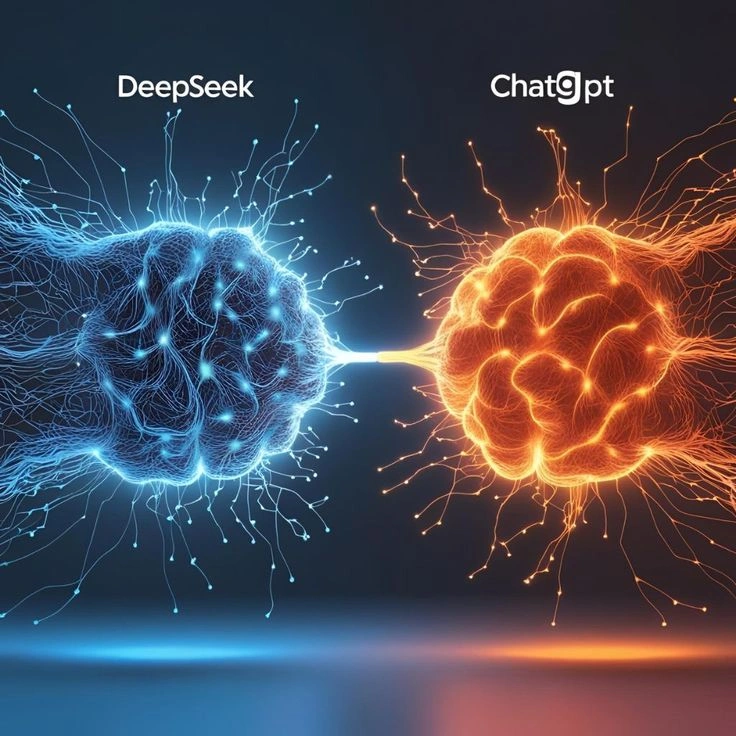
Performance Review: What Each Model Does Best
No discussion would be equivalent without reference to DeepSeek vs ChatGPT performance, which everyone is talking about now. Performance can vary by type of task; there is no single model that is best across the board.
As compared to ChatGPT 4, it is exceptional in generating narratives, creativity ideation, or any task requiring emotional intelligence. Ambiguity is not a challenge for ChatGPT, and it will produce great results in content writing, brainstorming, storytelling, summary of research, proposing marketing strategy, and multi-pronged problem solving that requires human-like reasoning.
Further, the potential conversational depth of ChatGPT surpasses DeepSeek as far as reliability for longer-term dialogue and continuity across topics.
DeepSeek R1 excels in categories of work where speed, accuracy and logical clarity matter most. DeepSeek generates sharp, formatted answers that work extremely well in programming assistance, deductive reasoning, strategic scientific explanation, structured problem solving, and applying logic involving multiple steps quickly.
Its low computational cost, particularly if the tool is used at an enterprise scale and generating thousands of requests a day, only improves its value as a scalable solution.
The performance differences also illustrate a deeper truth. The important question becomes Is DeepSeek better than ChatGPT, or, instead, which model addresses your needs most directly? DeepSeek outshines ChatGPT in efficiency matters.
ChatGPT rules the day when depth matters. Both models are improving. Both models serve their purposes well, and both show promise of getting even better.
Benchmark Insights: The Data Behind the Debate
Benchmarks are key to understanding performance in real-world situations. In comparing DeepSeek vs ChatGPT, analysts have established benchmarks that provide some patterns that clarify the ongoing conversations about both models.
The benchmark tests indicate that DeepSeek is performing remarkably well at structured reasoning tasks. It handles mathematics, formal logic, coding problems, and symbolic problems with an unexpected level of consistency.
The speed of the system continues to provide a smoother workflow in volume situations. Speed is extremely useful in coding platforms, research automation, or prompt technical review.
ChatGPT is still at the top in terms of linguistic comprehension, creativity, and complex reasoning tasks. It recognises nuances, interprets deeper instructions, or responses that are more fluid, context-based answers. Benchmarks demonstrate a higher level of reliability in abstract resolution, dialogue retention, tone control and emotionally responsive engagement.
The benchmarks indicate the models fit for different audiences; DeepSeek for those technical and data-driven audiences, and ChatGPT for those working in creative, strategic, or professional situations.
The Key Question: Is DeepSeek Better Than ChatGPT?
It is the question that headlines every debate and appears in nearly every forum. Is DeepSeek better than ChatGPT? The editorial answer is that neither model can be universally declared superior. Their strengths diverge because their design goals diverge.
DeepSeek is better for users who prioritise affordability, structured reasoning, fast computation, and repeatable logic-based tasks. ChatGPT is better for users who require creative intelligence, polished writing, complex strategy support, conversational nuance, and reliable long-form coherence.
The strength of one does not diminish the relevance of the other. Instead, they represent parallel approaches that broaden the spectrum of AI power.
The Broader Context: How Alternatives Influence the AI Landscape
The rise of DeepSeek has intensified interest in ChatGPT alternatives, especially for businesses experimenting with cost-effective automation or multifaceted AI workflows. Organisations are increasingly blending models rather than depending on a single system. This diversification increases experimentation and accelerates innovation.
The parallel comparison of Claude AI vs ChatGPT shows a similar trend. Users evaluate models based on reliability, creativity, safety, and reasoning. Claude has found a dedicated audience due to its calm tone and ethically aligned approach, while ChatGPT maintains a wide lead in creative thinking and global adoption.
These alternatives highlight the evolution of AI from a monopolised domain into a diverse ecosystem where each model contributes unique strengths.
Final Verdict: A Market Shaped by Competition, Not Replacement
The time when one service dominates an entire space is over. The DeepSeek vs ChatGPT debate signifies a shift towards competitive acceleration as opposed to simple dominance. DeepSeek represents efficiency, breakthrough value, and speed of delivery. ChatGPT's strengths are reliability, depth, and creativity.
Competing for winners is creating a space that is expanding more than any other time in digital history. From a business perspective, the most prudent course of action is not picking the model that has the most buzz or is the most marketable, but that which serves long-term strategic direction.
The future of AI will not be a single victor, but rather a variety of intelligences working in concert to shape a new thinking around how the world will think, build and innovate