Table of Contents
- Understanding the Phenomenon: What Are AI Hallucinations Really?
- What Causes AI Hallucinations: An Editorial Breakdown
- Factors That Increase Risk: What Are Some Factors That Can Cause Hallucinations in AI?
- How to Prevent Hallucinations in AI: Strategies That Actually Work
- Practical Safeguards: How to Avoid AI Hallucinations in Daily Operations
- Why the Issue Matters Even More After DeepSeek vs ChatGPT Conversations
- Final Verdict: Accuracy Is the New Benchmark of AI Maturity
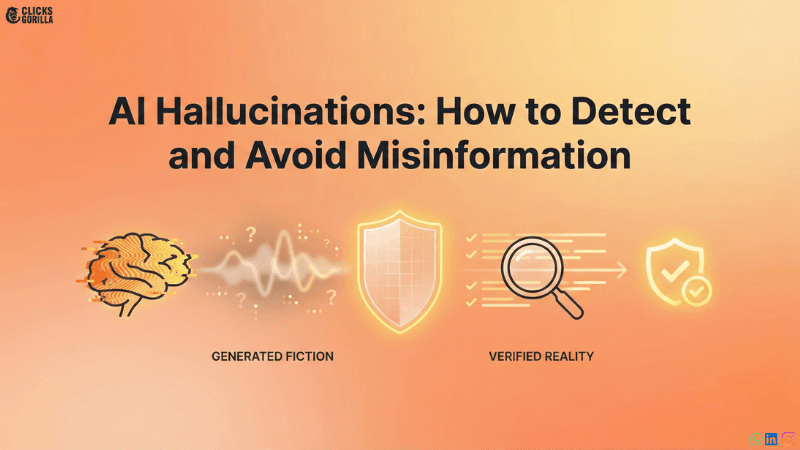
Artificial intelligence plays a central role in how societies function, impacting everything from education and journalism to research and enterprise automation. However, as these systems gain power, they remain inherently vulnerable.
The rising concern over AI hallucinations highlights just how critical accuracy has become in an era of abundant yet often unreliable information. Understanding these errors is no longer just a technical niche for developers; it is a business necessity.
This scrutiny is particularly intense in the ongoing comparison between DeepSeek and ChatGPT, where users rigorously analyse reasoning stability and error patterns. Given these risks, relying on unverified AI outputs is dangerous, which is why providers of SEO services in India like Clicks Gorilla advocate for strict human oversight and validation strategies
Both have improved in terms of reducing the frequency of hallucinations, but neither is immune to a variety of causes. That is what makes the prevention of this important and necessary.
Here is an in-depth editorial analysis of the causes, how to detect them, and how to avoid hallucinations in AI, written for professionals who expect clarity and credibility.
Understanding the Phenomenon: What Are AI Hallucinations Really?
The initial aspect of tackling the issue is comprehending what are AI hallucinations in the most practical way. Hallucinations are instances in which the AI system produces information that is not available in any of its training data or misaligns with factual reality in its response. The hallucinations sound smooth and confident, and thus, the user does not recognise that they are mistakes.
In more intuitive terms, what are hallucinations in AI can be thought of as is a human who confidently recalls a memory that did not happen. The information feels real, but it is not factually grounded and thus is false.
AI models are not lying on purpose. Instead, they are trying to fill out a pattern based on factual probabilities, and when those probabilities do not align with truth, we have a hallucination.
This is what makes the detection important since tone and confidence cannot identify hallucinations; only verification can identify hallucinations. After all, for systems that output content at scale, these risks are heightened.
What Causes AI Hallucinations: An Editorial Breakdown
Understanding what causes AI hallucinations requires looking at model architecture, training data, and prompt behaviour. The problem is multi-layered and extends far beyond simple errors in recall. The following factors play a dominant role.
Training data limitations: AI models build understanding from information that may be incomplete, outdated, or biased. When asked about points not covered in training, the model may generate plausible but incorrect content.
Overgeneralisation of patterns: AI learns language patterns rather than truth. If a pattern appears statistically reasonable, the model may produce it even when no data supports it.
Ambiguous or misleading prompts: When instructions lack clarity, the model attempts to fill gaps, often creating details that were never requested.
Lack of grounding in external sources: Models without real-time factual grounding may rely solely on internal patterns, increasing the risk of fabricated details.
Inconsistent reasoning structures: Some models struggle with multi-step logic, leading to incorrect conclusions even when the initial steps are correct.
Understanding these roots forms the foundation for developing strategies on how to prevent AI hallucinations in real-world usage.
Factors That Increase Risk: What Are Some Factors That Can Cause Hallucinations in AI?
Professionals often ask what are some factors that can cause hallucinations in AI, particularly when deploying models in corporate or academic ecosystems. Several external conditions can worsen hallucination rates.
- High pressure prompts that demand precise factual recall
- Requests outside the model’s trained domain
- Lack of context provided by the user
- Excessively creative instructions
- Complicated multi-part reasoning
- Outdated knowledge bases
Each of these scenarios increases the model’s reliance on guesswork. When algorithms attempt to fill knowledge gaps, hallucinations surface. For businesses and researchers, recognising these pressure points becomes a critical step in mitigation.
How to Prevent Hallucinations in AI: Strategies That Actually Work
Preventing errors begins with strengthening user control and improving model behaviour. The goal behind How to Prevent Hallucinations in AI is not perfection but reliable reduction.
Provide clear, context-rich instructions: AI performs best when boundaries and expectations are specific. Vague prompts increase error rates.
Ask for sources or reasoning: When users request step-by-step logic, the model reduces fabrication and improves factual grounding.
Use domain-specific models where possible: Specialised systems hallucinate less frequently than general-purpose conversational models.
Cross-verify responses with external trusted sources: This is crucial for research, legal, financial, or academic content.
Avoid forcing the model into uncertain territory: If the system indicates uncertainty, do not pressure it to guess.
Enable retrieval augmented generation when supported: This allows the model to draw from verified information rather than relying solely on internal predictions.
When implemented consistently, these practices significantly reduce the likelihood of misinformation, especially in workflows where accuracy is critical.
Practical Safeguards: How to Avoid AI Hallucinations in Daily Operations
Reducing errors in everyday usage requires ongoing discipline. Learning how to avoid AI hallucinations is about building habits that reinforce reliability.
- Use fact-checking tools or cross-reference databases
- Request explanations when answers seem unusual
- Break complex questions into smaller, clearer sections
- Avoid emotionally loaded or assumption-based prompts
- Review every output before publishing, sharing, or implementing
For organisations using AI in content creation, research, or marketing, establishing a verification workflow is essential. Even highly reliable models can hallucinate under pressure. Consistent review processes remain the strongest safeguard.
Why the Issue Matters Even More After DeepSeek vs ChatGPT Conversations
The recent interest in DeepSeek vs ChatGPT has raised new questions about accuracy levels. DeepSeek has become well-known for efficiency and yet for the ability to reason in a structured way. ChatGPT is noted for its nuanced writing, creativity, and larger context. Regardless of sophistication, both models can produce hallucinations in certain situations.
This comparison has advanced a global conversation. Users are looking for intelligence but also want more than that - they want transparency, an assurance of reliability, and factual verification. The competition based around these models has advanced innovation, yet has shown the urgency in the need to test and verify against misinformation across the industry.
The evolution of AI will not be solely measured by capabilities. It will be measured on trust.
Final Verdict: Accuracy Is the New Benchmark of AI Maturity
As AI continues to play a prominent role in professional, academic, and creative spaces, the demand for reliability is only going to increase. Consequently, understanding how to avoid hallucinations in AI and knowing what triggers AI hallucinations will provide the level of assurance in safety and accuracy we have come to expect in digital ecosystems.
Hallucinations will not go away, but with well-designed workflows, prompting with care, and good habits of verification, their impact can be kept reasonably in check.
The onus now exists with developers as well as users. Developers have to increase grounding. Users will need to utilise more caution and judgement in their interactions with AI.
Together, we can all together build a future where human capacity is augmented by artificial intelligence without compromises to the truth.