Table of Contents
- Let's start with the most common question: What is SaaS?
- What Is SaaS? A Simple Breakdown
- Common examples of SaaS:
- Key benefits of SaaS:
- What Is PaaS?
- Common examples of PaaS:
- What PaaS offers:
- What Is IaaS?
- Common examples of IaaS:
- What IaaS offers:
- SaaS vs PaaS vs IaaS: The Core Comparison
- SaaS
- PaaS
- IaaS
- A simple comparison using a housing example:
- The Difference Between SaaS, PaaS and IaaS?
- Decision-based guidance:
- Why SaaS Keeps Growing
- Fast-growing SaaS categories include:
- SaaS and SEO: Common Mistakes to Avoid
- Why SaaS Companies Hire Specialised SEO Agencies
- A good agency helps SaaS companies:
- When to Choose SaaS, PaaS, or IaaS
- Final Answer to the Big Question: What Is SaaS?
Most businesses encounter terms like SaaS, PaaS, and IaaS long before they truly understand them. The cloud landscape often feels crowded and overly technical, yet the core concepts are simple when stripped of jargon. If you want to understand what SaaS is, how it compares to other models, and how to make smart choices for your company, this guide will take you from confused to confident.
Let's start with the most common question: What is SaaS?
Simply put, Software as a Service (SaaS) is software you access over the internet rather than installing on your local hardware. It offers a distinct advantage in speed and convenience. Unlike hiring a Custom Web Development Company to build a bespoke platform from scratch, SaaS is ready to use immediately. Furthermore, the vendor handles hosting, security, and updates, lifting the technical burden from your team. This means you don't need to retain a Managed IT Support Services Company in India just to maintain servers or fix backend bugs; you simply log in and get to work.
To see the bigger picture, we need to talk about the cloud stack. SaaS is at the top of the stack. PaaS is in the middle of the stack. IaaS is the foundation of the stack. Each of these models has a different control you retain over your tools and how much responsibility you will delegate to your cloud provider. Let's go a bit deeper into SaaS vs PaaS vs IaaS so you can see how each one works and where each one belongs.
What Is SaaS? A Simple Breakdown
In business language, SaaS can be simply defined as software that works when you launch it. You do not have to build anything. You do not have to install anything. You do not have to deal with servers, updates or security patches. You simply sign up and start working. The onus is on the provider and not on your team or your company.
SaaS allows companies to alleviate operational headaches, free up time, and avoid much of the heavy lifting technically. For small and medium businesses, SaaS is particularly impactful because it offers access to software that once required massive budgets and in-house IT teams. For larger organisations, SaaS is valuable in helping to standardise processes across departments and functions without the need for extended adoption cycles.

Common examples of SaaS:
These tools share one thing: they run in the cloud and deliver instant value with minimal setup.
Key benefits of SaaS:
-
Lower upfront cost because you subscribe instead of buying licenses or hardware.
-
Automatic updates are handled by the provider, so your team always uses the latest version.
-
Fast onboarding since most SaaS tools are built for user-friendly adoption.
-
Easy scaling because you can add or remove users without changing infrastructure.
SaaS works best for companies that want quick results without technical tasks. If you need a CRM, project tool, email platform, or marketing system, you choose SaaS because it lets you focus on the work instead of the machinery behind the work. This is why SaaS dominates the business software world today.
What Is PaaS?
Platform as a Service is designed for developers who want to build applications without handling hardware, servers, or backend maintenance. If SaaS gives you ready-made software, PaaS gives you a ready-made foundation for creating software. It cuts down the time it takes to set up environments, configure databases, or manage operating systems. Developers can write, test, and deploy code faster because the heavy lifting is done by the provider.
Common examples of PaaS:
-
Google App Engine
-
AWS Elastic Beanstalk
-
Heroku
What PaaS offers:
-
Databases
-
Runtime environments
-
Development frameworks
-
Testing tools
With PaaS, your technical team focuses on building the actual product. The platform handles scaling, load balancing, and compatibility issues. This reduces complexity and risk. Companies use PaaS when they want to innovate quickly, experiment with features, or build internal systems without investing in expensive server management. It creates a clean path between the idea and the final application.
What Is IaaS?
Infrastructure as a Service delivers cloud-based hardware resources that you control completely. If SaaS is the finished product and PaaS is the workbench, IaaS is the raw materials. You get virtual machines, storage, and network tools that behave like physical hardware, only more flexible. Companies choose IaaS when they want full customisation without buying or maintaining physical servers.
Common examples of IaaS:
-
Amazon Web Services
-
Microsoft Azure
-
Google Cloud Compute
What IaaS offers:
-
Virtual machines
-
Load balancers
-
Network controls
-
Data storage
IaaS is the best option for organisations that need specific configurations, heavy computational power, or advanced security setups. It gives complete control over the environment, which is valuable for large-scale applications or industries with strict compliance rules.
Your IT team manages the operating system, software, and security layers, while the provider manages the physical infrastructure. This balance keeps your systems flexible and scalable without hardware costs.
SaaS vs PaaS vs IaaS: The Core Comparison
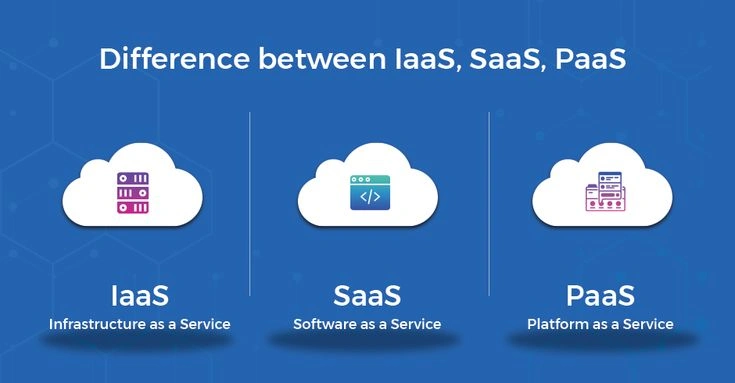
When you compare SaaS vs PaaS vs IaaS, the key difference is how much of the stack you manage versus how much the provider manages. SaaS sits at the top and removes almost all workload. PaaS sits in the middle and removes infrastructure tasks but keeps development responsibilities. IaaS sits at the bottom and gives near total control to your IT team. This layered structure helps you decide which model fits your strategy, resources, and timeline.
SaaS
-
You use the software.
-
The provider manages everything.
PaaS
-
You build software on a provided platform.
-
The provider manages the environment.
-
You manage the application you create.
IaaS
-
You rent the hardware.
-
You manage the operating system, software, and everything else.
A simple comparison using a housing example:
-
SaaS is a fully furnished apartment. You move in and live comfortably from day one.
-
PaaS is an unfurnished apartment. The building takes care of utilities, security, and maintenance, while you design and arrange the inside.
-
IaaS is an empty plot of land. You construct the house from the ground up.
This perspective shows the difference between SaaS, PaaS and IaaS clearly. SaaS gives speed and ease. PaaS gives creative freedom without hardware issues. IaaS gives total control over complex or large systems.
The Difference Between SaaS, PaaS and IaaS?
Understanding the difference between SaaS, PaaS, and IaaS helps you map out your technology strategy. SaaS is ideal when your priority is simplicity and fast deployment. PaaS is ideal when you need to build custom solutions but want to skip the infrastructure work. IaaS is ideal when you need control over configuration, security, and performance. Many companies combine them because each model solves a different problem.
Decision-based guidance:
-
If you want speed
-
Choose SaaS. Everything is ready to use from day one.
-
-
If you want to build custom apps without handling hardware
-
Choose PaaS. You get development freedom without server headaches.
-
-
If you want full control and customisation
-
Choose IaaS. You manage every detail of your environment.
-
-
If you want to reduce the IT workload
-
SaaS is the most efficient.
-
-
If your product depends on code
-
PaaS or IaaS may be worth considering.
-
-
If cost matters
-
SaaS keeps early expenses low, while IaaS becomes cost-effective when operating at scale.
-
Why SaaS Keeps Growing
SaaS adoption continues to accelerate because businesses want predictable costs, smooth onboarding, and less time wasted on maintenance. SaaS also supports hybrid and remote teams who need tools that work anytime, anywhere.
The pay-as-you-go model helps companies stay flexible when scaling up or down. Product updates arrive automatically, so teams never fall behind. These advantages make SaaS attractive for startups, enterprises, and everything in between.
Fast-growing SaaS categories include:
-
Automation tools
-
Collaboration tools
-
Analytics platforms
-
E-commerce tools
-
Industry-specific business platforms
Remote work has strengthened SaaS growth. Modern teams rely on tools that allow real-time collaboration, secure cloud storage, and instant communication. SaaS delivers all of this with far less overhead than traditional software.
SaaS and SEO: Common Mistakes to Avoid
Numerous SaaS companies continue to engage in the same SaaS SEO mistakes, dampening their growth despite their products being strong. One common mistake is that they focus on broad keywords instead of more directed keywords that clearly indicate intent.
Another error is that they neglect to focus on onboarding pages, which lowers the conversion rate despite an improvement in traffic. Many teams bypass clusters surrounding their content and simply publish articles or content without a strategy or structure.
Product-led SEO is underutilised as well. SaaS companies routinely forget that people search for products by features, integrations, templates, and solutions. Ignoring that content loses high-intent traffic. Some brands also ignore local SEO, which could help them own a regional market. Fixing these common errors leads to stronger organic exposure, increased sign-ups, and consistent growth.
Why SaaS Companies Hire Specialised SEO Agencies
Competition in the SaaS industry grows every year. High-ranking terms attract global competitors, and customers compare multiple platforms before choosing one. This is why many SaaS businesses hire a search engine optimisation agency in Dubai or agencies in other major cities. Dubai has become a global tech hub with agencies that specialise in scaling SaaS brands across regions with different languages, cultures, and search behaviours.
A good agency helps SaaS companies:
-
Build targeted keyword strategies
-
Improve technical SEO on complex websites.
-
Strengthen product pages and conversion flows.
-
Produce content built around features and use cases.
-
Create region-specific campaigns for global scale.
This mix of technical skill and market knowledge allows SaaS companies to grow faster while avoiding wasted effort.
When to Choose SaaS, PaaS, or IaaS
The choice among the three depends on a variety of factors, including the goals you want to achieve, your team's skill level, and the time frame within which you are trying to accomplish the work. If you are looking for a tool that just works without any need for technical knowledge or technology, then SaaS may be the direction you want to go.
It is the path of least resistance for teams that are looking for productivity without worrying about managing infrastructure. PaaS is best when you need to build custom applications. It allows you to spend less time developing, and it takes care of managing hardware and other technology along the way.
You might choose IaaS when you need control or when your system is too sophisticated to use a standardised tool.
Usually, most companies will use all three models at some point. You may run your communication through SaaS tools, your internal tools from a PaaS environment, and your critical systems on IaaS. The models allow for effortless stacking and allow you to grow at your own pace.
Final Answer to the Big Question: What Is SaaS?
SaaS is software delivered through the cloud. It lets you skip installation, skip maintenance, and skip expensive hardware. When comparing SaaS vs PaaS vs IaaS, SaaS is the simplest. PaaS is the middle ground. IaaS is the most technical. Now that you understand the difference between SaaS, PaaS and IaaS, you can match your business goals with the right model.
If your business depends on online visibility, avoid the common saas seo mistakes and consider working with an expert partner, such as a search engine optimisation agency in Dubai, especially if you want to expand into competitive markets.
This advantage is universal, whether you run a multinational corporation or a growing web designing company in Indore, the right software foundation is the key to scaling effectively. This captures the true value of understanding SaaS. To ensure you select the infrastructure that best fits your goals, strategic partners like Clicks Gorilla are ready to guide your digital transformation.