Table of Contents
![What Is a Blockchain & Its 4 Different Types [2026 Update]](/_next/image?url=%2Fuploads%2Ful09o5r92p60hd7rc0txdb0se.png&w=1920&q=75)
Blockchain has progressed from a small technical idea to one of the most transformational technologies regarding what it means to live and work within a digital world. Businesses across finance, ecommerce, supply chain and healthcare are now calling for a straightforward and easy-to-read beginner's guide to blockchain that clearly outlines the basic principles of the technology.
With even more industries leveraging decentralised systems in their day-to-day operations, it is paramount that leaders, developers and decision-makers understand clearly what blockchain technology is.
This beginner's guide by Clicks Gorilla, a premier provider of cloud virtualisation services in India, has been updated for 2026 and explains the definition in depth, outlines how blockchain technology works, describes all major types of blockchain and explains how the technology is shaping industries on a global scale.
Whether you want to discuss potential enterprise adoption or explore new digital initiatives for e-commerce, this beginner's guide will offer clarity on the fundamentals of the technology.
What Is Blockchain
A blockchain refers to a digital ledger that is shared and decentralised, which stores records in a secure and tamper-proof manner. Every piece of data is stored in a block and linked to the previous block, creating a chain of approved entries.
This explanation is the core definition of what blockchain technology is, and is a term that has become commonplace as industries begin to access a more transparent and secure method of storing data.
Unlike most databases that are controlled by a central organisation or governing body, blockchain systems can use many computers, called nodes, to maintain the ledger. The nodes approve and validate the entries and create shared trust amongst each other without relying on a single organisation.
This reason has made blockchain appealing for uses such as financial transactions, smart contracts and blockchain technology for e-commerce, where transactional trust and verification must occur.
How Blockchain Technology Works
To understand how blockchain operates, it is important to have an understanding of the various parts of the system. Each block in the chain has information like transaction data, a timestamp, and a cryptographic hash.
This hash connects each block to the previous block, which provides immutability to the record. This means that data cannot be changed without changing all the blocks in the chain.
Every new block is validated by a decentralised network of nodes. Each of those nodes operates with a consensus mechanism, like Proof of Work or Proof of Stake, to agree on what is added to the ledger. This stops fraud and ensures accuracy. These mechanisms are essential in understanding how blockchain works in real applications.
Cryptography ensures identities and data security. This system is transparent and traceable, making it immensely difficult for any malicious actor to change the records. This characteristic also establishes blockchain technology as a sensible trust-based system.
For a beginner's guide to blockchain, this verification method is likely the most important concept to grasp.

Key Features of Blockchain
Blockchains offer several features that make them valuable across industries. These characteristics are discussed in almost every technical reference and are essential to understanding the technology.
Transparency: All transactions stored on a blockchain can be viewed by participants. This is valuable in sectors that require monitoring, auditability and public verification.
Immutability: Once data is added to the chain, it cannot be altered. This ensures integrity, especially for legal, financial or supply chain records.
Decentralisation:Instead of relying on a central authority, blockchain distributes decision-making across nodes. This reduces dependency on a single party and increases resilience.
Security: Robust cryptographic principles protect transaction data, making blockchain extremely resistant to tampering. A proper beginner's guide to blockchain explains these features clearly since they shape its value across sectors.
The 4 Different Types of Blockchain
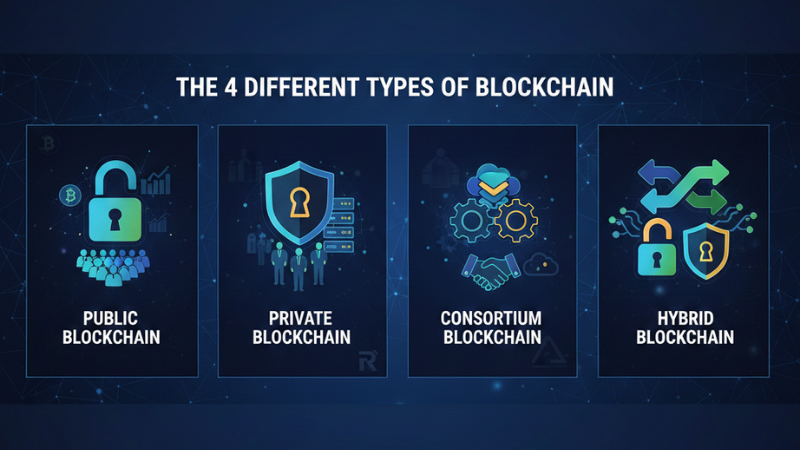
Understanding the types of blockchain is essential because each model serves different business needs. Modern organisations evaluating blockchain technology often focus on these classifications to choose the right structure.
Public Blockchain: A fully open network where anyone can participate, validate transactions and access data. Bitcoin and Ethereum are well-known examples. Public blockchains offer high transparency but may be slower due to global participation. Public chains are integral to early adopters learning through a beginner's guide to blockchain.
Private Blockchain: Controlled by a single organisation. Access is restricted, and the network is permissioned. This model is ideal for regulated sectors, internal operations and enterprise workflows that require audit control.
Hybrid Blockchain: Combines public and private components. Organisations control specific processes while allowing certain areas to remain open for verification. This offers flexibility and is suitable for industries where controlled transparency is needed.
Consortium Blockchain: Governed by a group of organisations rather than one. This is the preferred model for industries that require shared trust, such as logistics, banking and healthcare.As businesses explore types of blockchain, these four models offer clear pathways to adopt the technology at scale.
Real World Applications of Blockchain
Blockchain is now widely adopted across industries beyond cryptocurrency. Its ability to provide secure and verifiable records makes it valuable in several areas.
- Finance and Payments
- Supply Chain Management
- Healthcare Data Management
- Blockchain Technology for E-commerce
- Enterprise Governance
Organisations use blockchain to automate workflows, approval systems and compliance processes.
The most advanced beginner's guide to blockchain includes these practical applications because they show where blockchain fits into modern technology ecosystems.
Benefits of Blockchain
Blockchain offers several advantages for companies adopting the technology.
- Better security and reduced risk of data tampering
- Transparent operations and easy verification
- Efficient automation through smart contracts
- Lower costs by removing intermediaries
- Faster processes for settlements and approvals
These benefits explain why organisations worldwide explore how blockchain technology works before integrating it into large-scale systems.
Challenges of Blockchain
Despite its strengths, blockchain presents challenges that industries must consider.
- Limited scalability in large public networks
- High energy consumption for certain consensus models
- The need for skilled developers and system architects
- Regulatory uncertainty in many countries
These challenges are part of the conversation in major blockchain events in Dubai, where experts discuss best practices and enterprise adoption strategies. Businesses also examine blockchain terms more closely to navigate technical and legal frameworks.
Future of Blockchain in 2026 and Beyond
As adoption grows, 2026 marks an era of enterprise innovation.
The future of blockchain includes:
- Interoperable blockchains connecting multiple networks
- Scalable and energy-efficient consensus models
- Growing use in e-commerce, logistics and real estate
- Global expansion through conferences such as the blockchain events in Dubai
- New enterprise frameworks that integrate AI and decentralisation.
With industries focusing on security transparency and automation, blockchain becomes a major pillar in global digital transformation.
Conclusion
Blockchain is still stepping up as a secure and decentralised data management infrastructure. Fostering knowledge around what blockchain technology is, through an easy-to-understand beginner's guide to blockchain and types of blockchain, prepares organisations to onboard future-ready systems. As other industries begin to understand how blockchain technology works, new opportunities expand across e-commerce, logistics and enterprise operations.
As global interest builds, with significant innovations driven through blockchain technology for e-commerce, 2026 will be a cornerstone year for adoption. Understanding the principles, features and applications of blockchain technology in the guide assists businesses to clearly understand how blockchain technology can be used to embed success digitally for years to come.